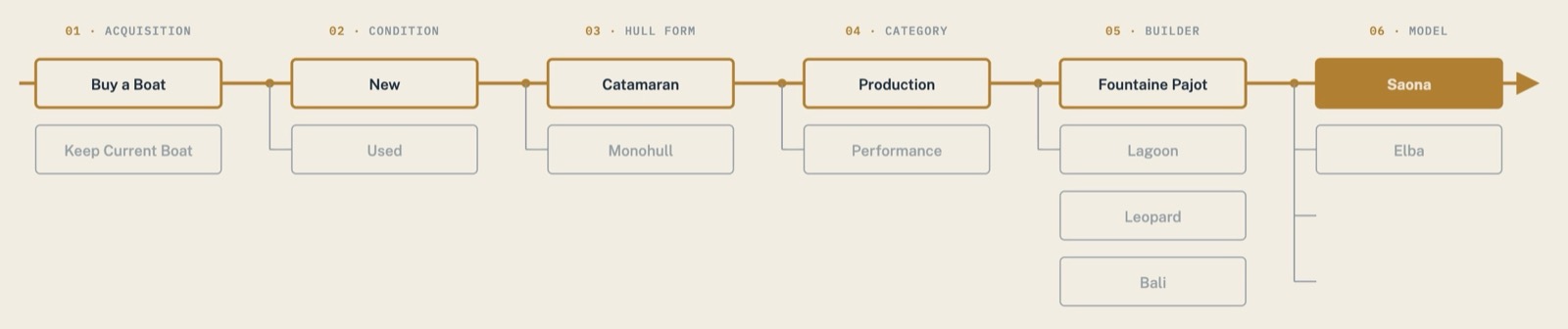
Boat buying decision tree
The Plan
After spending four years sailing a Beneteau 41.1 (a mono hull) in the Pacific Northwest, we thought about expanding our explorations from part-time sails close to home to full-time live aboards, exploring Europe and even one day sailing around the world. The Beneteau had the advantage that it was paid for and we were familiar with it, but there were some problems if we wanted to use it as our floating home for our future adventures:
- It would be a challenge to fit all the gear we would need/want onboard for a multi-year voyage
- The Beneteau would need many upgrades: lithium batteries, solar, water maker, etc.
- Heeling (as monohulls tend to do) for days on end would be tiresome
- We’d have to get it to Europe - either shipping (expensive) or sail it ourselves (arduous)
- Standing watch requires being in the cockpit exposed to the weather (catamarans can generally be handled from the saloon)
So we resolved we would sell the Beneteau and buy a new boat suitable for full time live aboard, off grid, and ocean crossing capable. Early on we decided on a catamaran so it was just a matter of deciding the make and model. Here is my view of the pros and cons of monohulls and catamarans:
Monohull
Pros:
- less cost for same length
- adjust to wind gusts by heeling (so the rig can be lighter compared to an equivalent catamaran)
- better up wind sailing
- more enjoyable “feel” when hand steering
- marina fees usually less than same length catamaran
- can be loaded with extra gear without affecting performance overly
- only one engine to maintain
Cons:
- heeling under sail
- if flooded, the boat will sink to the bottom of the ocean
- less living space
- need to be in cockpit to drive the boat
- deep draft to support the keel
- engine can be difficult to access
- “living in a cave” feel when in saloon
Catamaran
Pros:
- more living and storage space
- no heeling
- more comfortable in high swell (less rolling compared to a monohull)
- can navigate from saloon (staying out of inclement weather)
- typically sails better downwind compared to monohull
- built in redundancy (two engines, two rudders)
- larger area for solar panels
- private owners cabin (less likely your guests in the other hull will disturb you)
- if holed, will usually stay afloat (no keel to drag the boat down)
- shallower draft (again no keel)
- engines easier to access (generally an engine bay at the stern of each hull)
- more area for solar panels
Cons:
- more expensive
- marina fees can be 1.5 to 2x higher (if they even have space for you)
- two engines to support
- higher windage
- critical to reef in higher winds (boat can’t bleed off excess wind by heeling)
- can be hard to find a haul out facility
- if capsizes will happily stay in an inverted position (though I’m not sure this has ever happened to a production cat)
- poor upwind sailing (more leeway for a given wind angle)
- poor performance if over loaded
So there are pros and cons to each, but our view (at least as a live aboard platform) the catamaran wins out. One thing to consider when weighing these factors, is that likely 90% of your time will be at anchor, not sailing. So you’ll want to consider benefits at anchor just as much (or more) as sailing aspects.
Another perennial question for potential boat buyers is used vs new. Buying a used boat saves quite a bit of money compared to a new build, but at the time we started looking (2020) there were not many suitable models on the market, and the covid pandemic made traveling to view boats a challenge. Also, our thinking was that choosing a new boat would allow us to pick the options we wanted rather than having to start with whatever the previous owner had set up. So we focused on looking at the new boat market for catamarans. Well that narrowed down to a few hundred options - how to proceed?
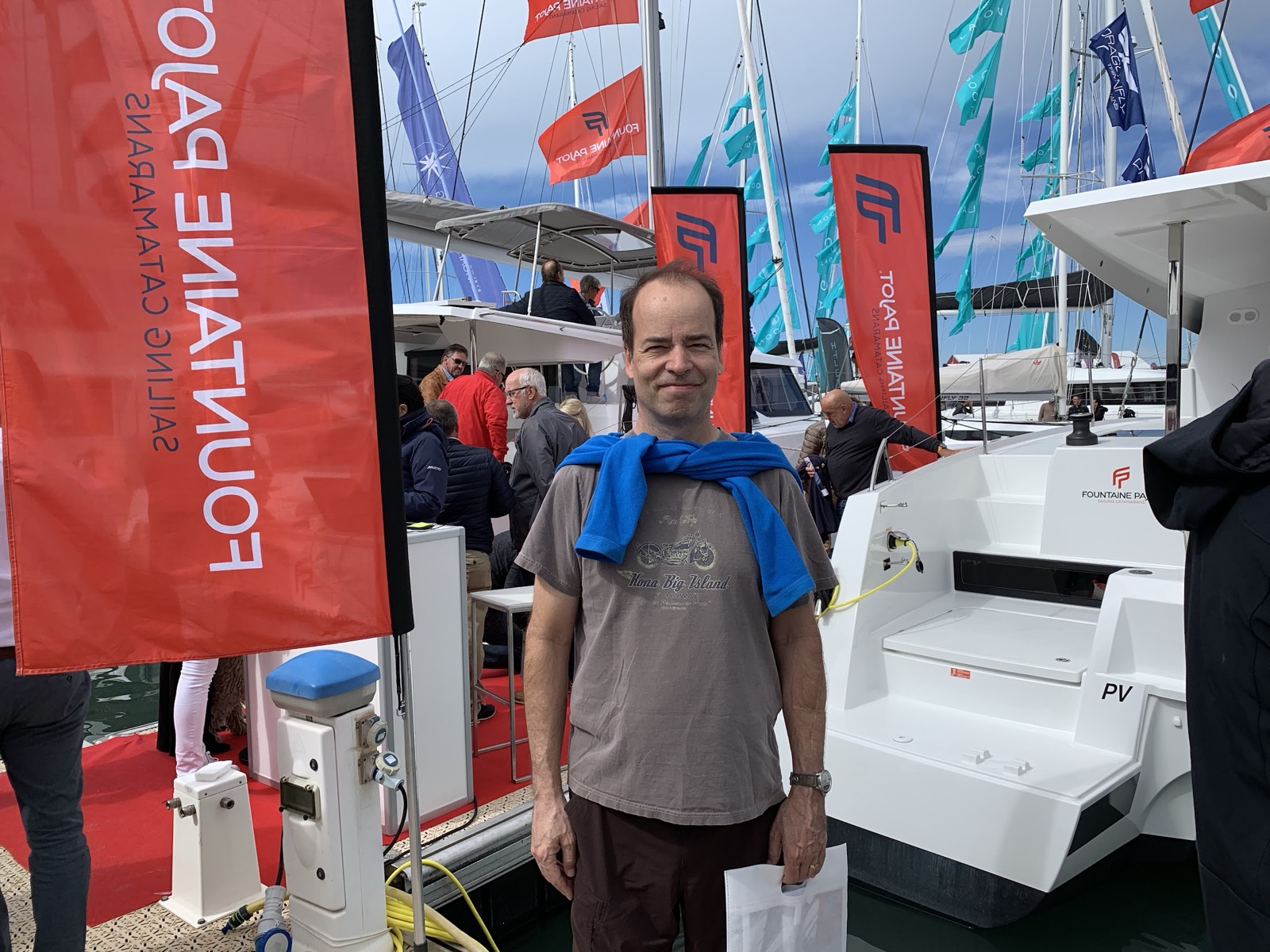
In 2019 we were in France and took the opportunity to attend the Grande Motte boat show. In Seattle you see precious few catamarans, so this was a good chance to actually get on some boats. It’s the world’s largest exclusively catamaran sailboat show. It was chance to see a variety of brands and models: Lagoon, Leopard, Bali, Catana, Balance, Privilege, and others. It was quite rushed and hectic but it did afford us the opportunity to actually step on a few different boats and talk with the builders. It would be better to actually test sail several different boats (or do a series of week long charters), but given time and money constraints we had to go on what we could see at the boat show and information from boat reviews.
The four big brands in the catamaran world are: Bali, Lagoon, Leopard, and Fountaine Pajot. There are several brands (HH, Outremer, Balance) that are targeted at the performance end of the market. These are quite a bit more expensive than the big production brands, and the actual interior volume is much less than you’d expect for a given length (skinner hulls, space taken up by the dagger boards, larger trampoline area, etc.). There are also a bunch of boutique brands (such as Antares) we could have gone with, but these are generally more expensive and have longer build times than the large production builders (though now I can appreciate the advantages of dealing directly with the builder rather than going through a dealer). The downside of the “big four” is that they primarily sell to the charter market so in general there are built to a cost point, have modest performance, and require an extensive set of options to be suitable for cruising. Still all in all, one of the big four seemed our best bet.
Since we wanted to pick up the boat in Europe, Leopard was out as these boats are all made in South Africa, which would require a long sea voyage right at the start. The other three are conveniently all made in France, so that left us with Bali, Lagoon, and FP to choose from. From reviews I had read, Bali sailboats did not sail very well (heavy with less sail area), so it was out. Lagoon is the biggest of the catamaran builders, but I didn’t like how the helm station was on top of the couch roof. It left the helmsman cut off from the main part of the boat and meant that the boom was even higher off the deck. On the other hand the FP helm stations were just a half-step up from the cockpit deck. The helmsman had a good view forward but was also near the saloon and cockpit which made communication easier. Aesthetically, I found FPs more pleasing than the Lagoons (both of which must be said are quite modern looking and not at all what a traditionalist sailor would desire). I guess like all production boats, Fountaine Pajot annoyingly pinches pennies, especially over things that potential buyers at the boat show aren’t likely to notice. E.g. FP uses plastic sheaves at the boom and masthead that are sure to break down after a few years. But most such issues can be addressed without too much cost or effort and I’d say FP (along with Lagoon and Leopard) catamarans are certainly capable of crossing oceans. Certain YouTube videos try to convince you that you are taking a great risk using one of these boats for blue water sailing, but if you look at the statistics from the ARC rally (the largest rally crossing the Atlantic), you’ll see most of the boats are production models and they fare just as well as the more expensive brands.
So anyway, we decided on the FP, but what size? FP had models from 40 ft to 67 ft. Smaller is cheaper, but has less room and sails slower. On the other hand, beyond a certain size cost (both purchase and operating) go up exponentially and beyond 50 ft you would generally need a professional crew to manage it. After some consideration we decided something around 45 ft would be best (most cruising couples end up at something close to this size as well). FP had two models that were just a couple of feet apart in size: the Elba 45 and the Saona 47. After some waffling we eventually went with the Saona. Besides being slightly larger, it had twice the fuel capacity of the Elba. Also, the Saona had a nice feature in that you could access the forepeaks from the hull rather than having to go through a deck hatch.
Most catamaran models (Saona included) come in a charter configuration that maximizes the number of cabins. These account for the vast majority of units sold for any particular model. Thankfully, there is also a configuration aimed at the non-charter market. These typically have one hull that is a dedicated owner’s hull - more storage space, larger bathroom, desk area, etc. Naturally, this is the configuration (called Maestro by FP) that we chose.
Of course, having decided on a boat it’s not like we could just fly to France and pick one off the showroom. There was a long waiting list, and you had to sign up for a “build slot” which got you in the queue to get that boat as it came off the line in a year or two. Some months after we had made our down payment we were told that the Saona model was being replaced by a new model, the Tanna, and that would be our boat! There was no actual Tanna that had been built at that point, so all we had to go on was the CAD renderings like you see here. It was a bit worrisome, but what could we do other than start all over again?
On learning more about the Tanna it turned out it was more of an update than a complete new model. Same hull and cabin layout as the Saona. The big change was in the saloon which was redesigned: the center island was gone as well as the forward facing nav desk. Instead of a nav desk there was a standing area by the door for the chart plotter and VHF. I wasn’t especially happy about these changes but eventually started to see the positive features in the new arrangement (e.g. it was convenient to enter through the door and have the plotter right there). In addition there were several technical improvements made based on problem that had come up with the Saona (e.g. water drainage was improved). The cable steering on the Saona was replaced with hydraulic steering, which, while it didn’t have the same “feel” as the old system, was more reliable. One thing that took some getting used to is that with hydraulic steering there’s no need to “lock” the steering wheel to keep the rudders fixed, the rudders would only turn based on turning with the wheel.
So we had decided on the boat! The next step was deciding on what options to have. There were factory options (those provided by Fountaine Pajot) and after-market (ones to be installed by 3rd parties). In the next two sections we’ll discuss which options we considered and ultimately chose to get.
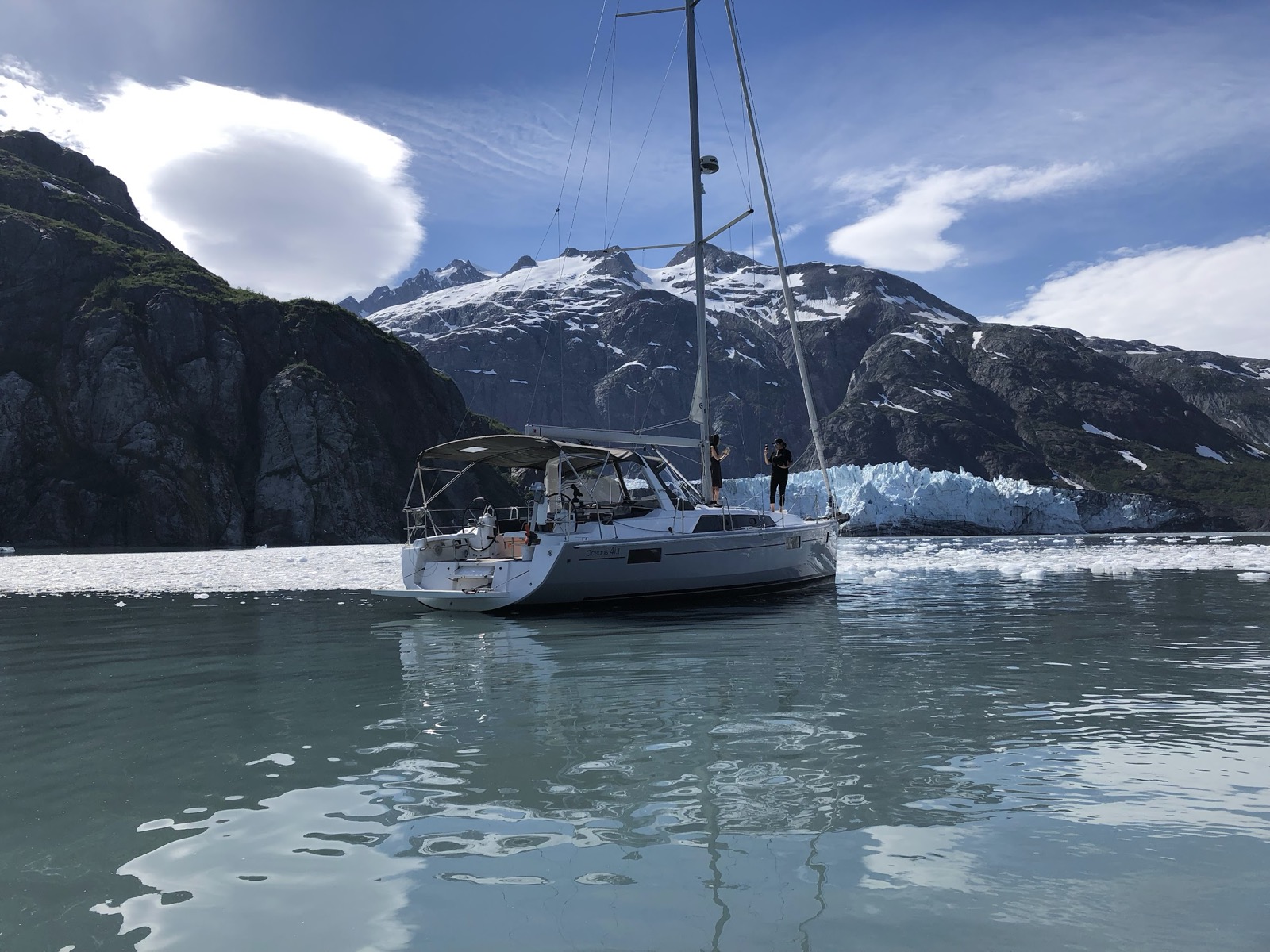
Our Beneteau 41.1 in Alaska
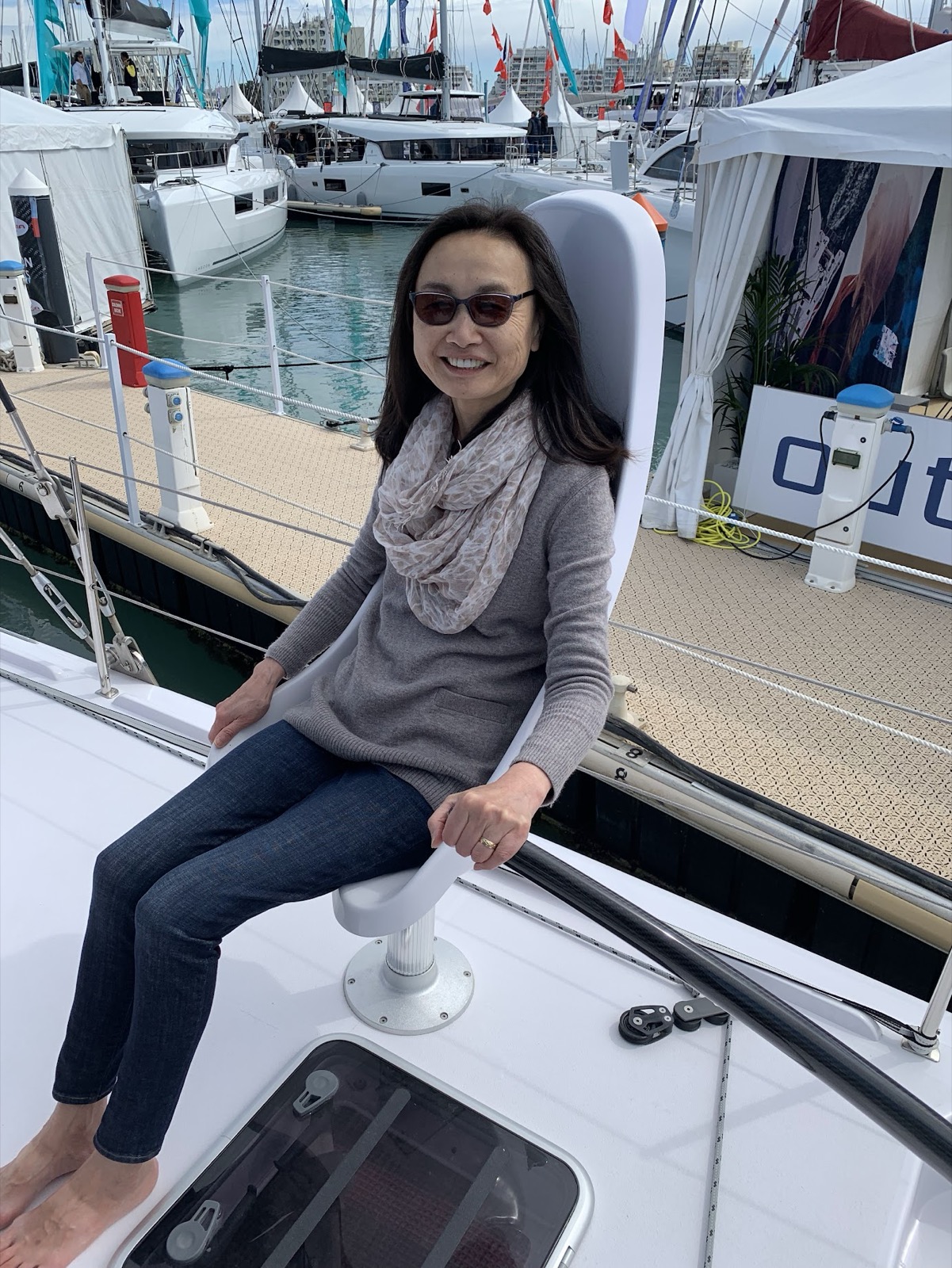
Test driving an Outremer - you can tell it’s sporty by the carbon fiber tiller
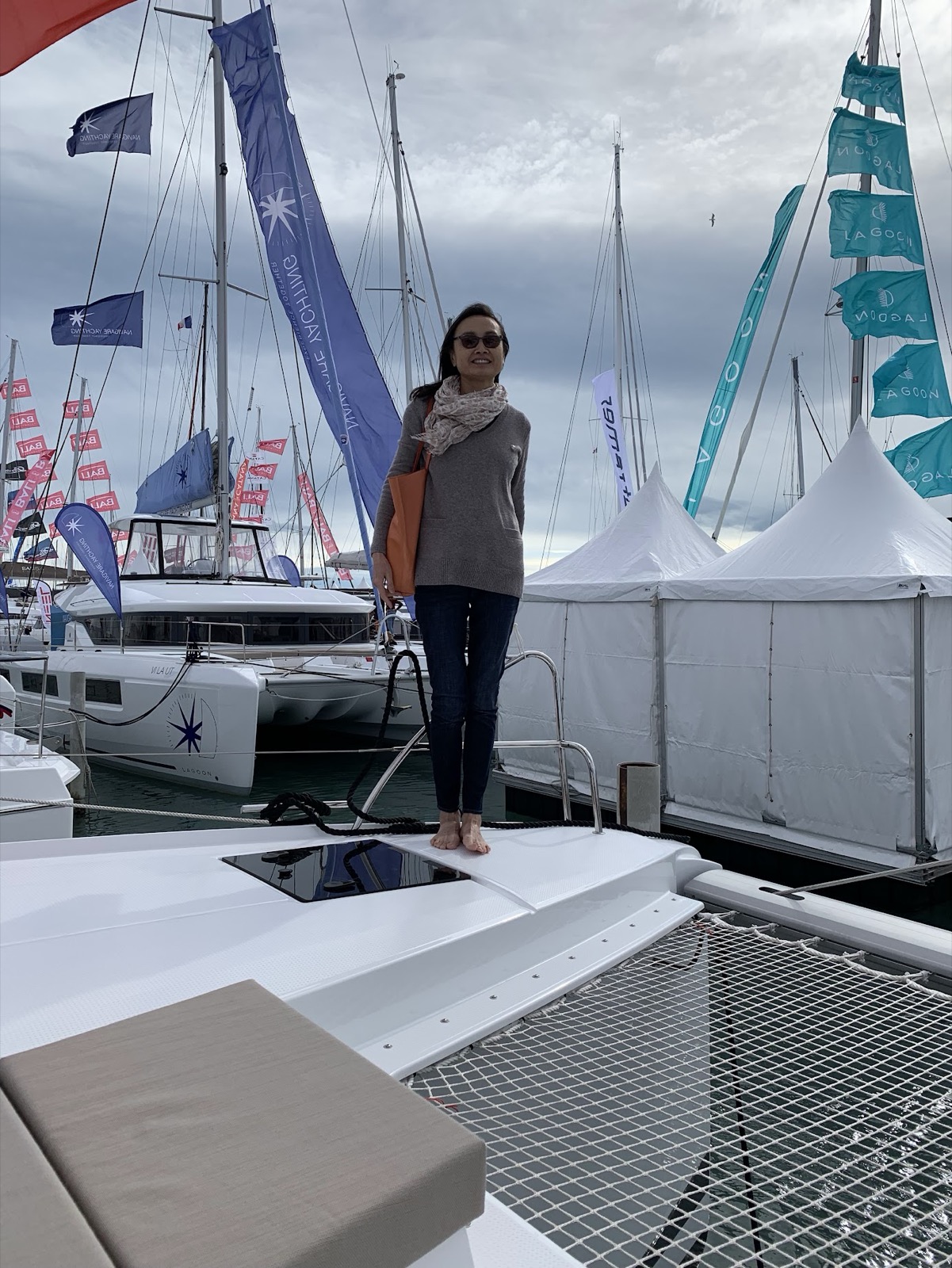
On the bow of a Fountaine Pajot