Choosing from the long list of factory options for our new boat
Many new boat buyers get only a minimal number of factory options. Their thinking is that they will have more flexibility and/or lower costs having the particular options they want installed after delivery. For my part, I feel that it’s almost always better to go with the factory option if it’s at all acceptable. Some things (like air conditioning) are much more complicated to install after construction. Even if the the cost is lower, the time and trouble to get items installed later can greatly out weigh these savings. Also, we didn’t have many particular preferences (say Raymarine vs Garmin for the plotter) and were generally happy to go along with FP’s choices.
One area where we did want to go our own way was the galley. We wanted to have a pure electric galley (oven and stove). FP didn’t offer this option at the time, so we had to have these installed ourselves. Reputedly, FP didn’t offer lithium batteries or a charging system other than a diesel generator, so we worked with IntegrelSolutions to setup the electrical system (more in a later post).
In this post though, I’ll list each of the FP factory options, its prices, and how we decided to get it or not.
The base price of the Tanna 47 Maestro (as of Oct, 2020) was $698,941. What we ended up paying to FP was $897,557. The difference of $198,616 where options we arranged with FP. Some of these you might think would be included in the base price (sails for example), but no, a no options boat is pretty bare bones (I doubt anyone has ever managed to order a boat without a single option).
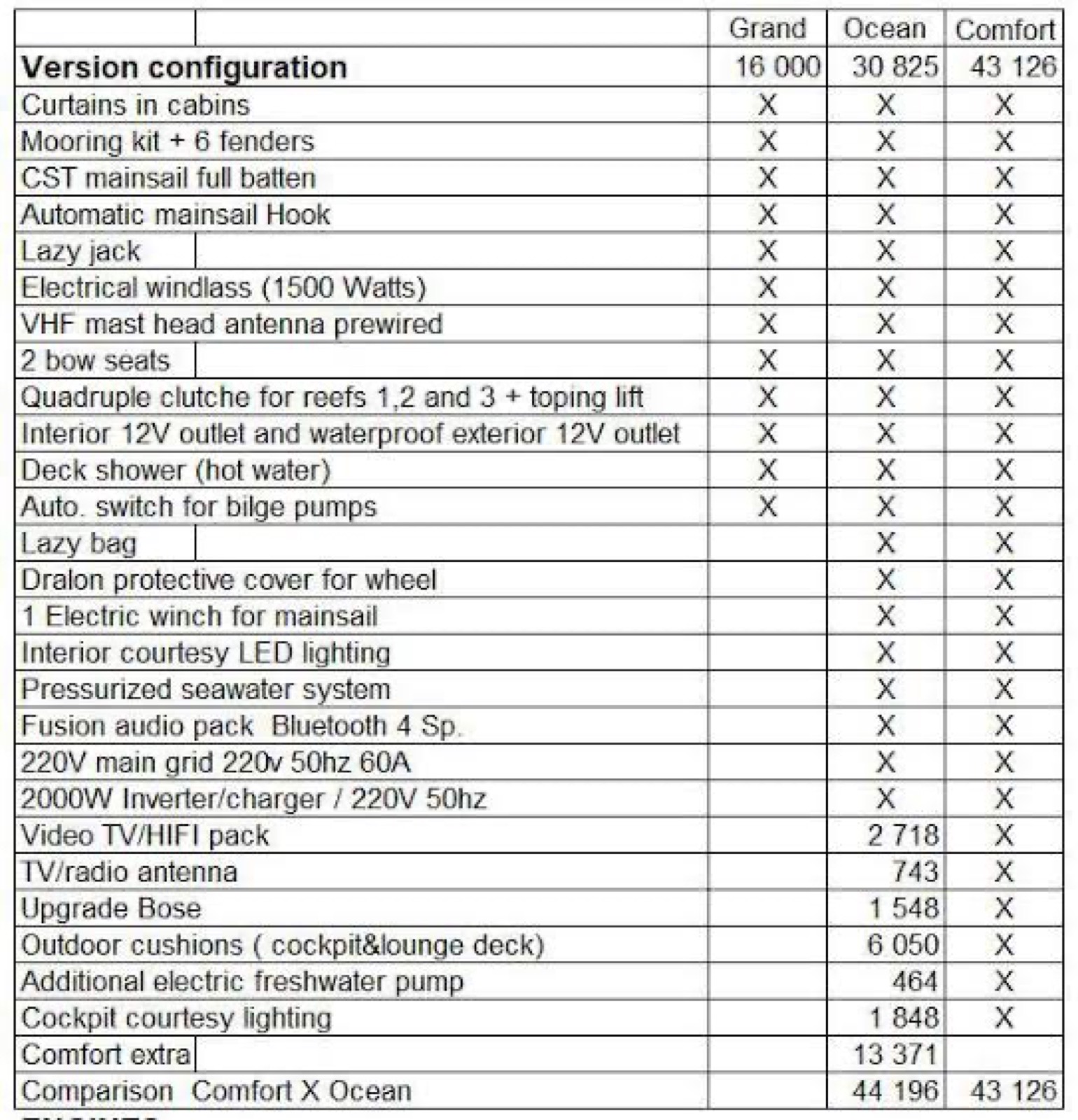
To make the ordering process a bit easier, some standard sets of options are grouped together in packages. The most extensive of these is the comfort package which is what we ended up getting (for $82,500). Though there are a few things in this package that we didn’t particularly need (TV ariel for example), the package discount meant that we were better off with the package vs picking and choosing.
So what do you get with the comfort package? This is the list:
- Curtains
- Deck shower
- Mooring kit and 8 fenders
- Full batten mainsail
- Mainsail hook
- Lazy jack
- Electric windless (1500 W)
- VHF antenna
- Reef clutches
- 12 V outlets
- Bilge pumps
- Lazy bag
- Electric winch for mainsail
- Electric winch for genoa
- Outdoor cushions
- Wheel cover
- Courtesy LED lighting
- Pressured seawater system
- Integrated solar 1700W
- 220 V main grid
- 2000 W inverter
- Fusion audio pack, 4 speakers
- Video TV pack
- TV/radio antenna
- Upgraded base
Most of these are things which we’d definitely need or are nice to haves (like the stereo system). Some items like the electric winch or windless could be optional on a smaller boat (we didn’t have electric winches on the Beneteau), but on a boat the Tanna’s size, are pretty much mandatory.
The one item that we had our biggest hopes for (and turned out to be somewhat disappointing) is the integrated solar. This is a set of flexible Solbian solar panels that are placed around the coach roof. In comparison to a meta arch placed on the stern or typical flexible panels with wired dangling out, the Solbian setup looked very slick. In practice though we never saw anything close to the 1700 W rating and would max out at 700 W. This didn’t meet all our electrical needs, so would require additional power to be added to the batteries every other day or so. Eventually (2026) we ended up getting a solar arch to supplement what we were getting from the Solbian panels. One last point, some people have reported the Solbian panels deteriorated over time (delaminate), but four years on, ours still look nice.
So are we done? Not by a long shot. Next we have factory options that are not part of the comfort package…
| Item | Cost | Notes |
|---|---|---|
| Garmin, Autopilot, VHF, AIS | $20,625 | 12" display in saloon, 10" at helm, AIS transceiver |
| Heating system | $15,477 | Webasto Hadronic system with per-room thermostats |
| Watermaker 12V 90L/h | $13,113 | Aquabase watermaker |
| Bowsprit and gennaker gear | $7,769 | bowsprit and furler for code-zero |
| Volvo D2 60 engines (2) | $7,520 | upgrade from std D2 50 |
| Fresh water toilets (3) | $4,311 | less smelly than sea water toilets |
| Antifouling | $4,043 | ablative antifouling |
| Radar | $3,573 | mast mounted |
| Forward scan sonar Garmin PS 51-TH | $3,457 | detect underwater obstructions |
| On board training | $3,250 | 3 days of coaching |
| Underwater lighting 2x21W | $3,177 | two rather dim LED lights |
| 3-blade folding props | $3,094 | upgrade over fixed props |
| Cockpit fridge | $2,420 | small fridge int the cockpit for drinks |
| Freezer 12V 90L | $2,311 | in addition to the frig that comes standard |
| Saloon table | $2,115 | larger dining table convertible to a bed |
| Dishwasher | $1,991 | under the sink, one drawer dishwasher |
| PVC outdoor upholstery | $1,500 | cushions? |
| Ex-factory | $1,291 | random charge for delivery of boat from factory |
| PROFURL genoa furler | $1,250 | Upgraded furler |
| US Export/import documentation | $1,105 | required documentation for US buyers |
| Anchor chain counter | $723 | Tracks amount of chain deployed |
| VHF for helm station | $525 | talk on VHF while driving the boat |
| Garmin remote autopilot | $379 | steer the boat while lounging on trampoline (rarely used) |
| Additional mooring cleat | $337 | extra cleat on transom |
So on top of the $82,500 comfort package, we have another $105,396 of factory options.
Some additional comments…
For the Garmin option we definitely wanted to have a plotter in the saloon in addition to the helm station. This enables us to keep an eye on things from a sheltered location in inclement weather. You can even change course using the plotter, so other than adjusting the sails or throttles you don’t need to go outside. Also, don’t think your 20K gets you actual charts - you need to buy chart cards for the region you’ll be sailing in separately.
This is what came with our Garmin package:
- GPSMAP 8410 - 10 inch chart plotter - helm
- GPSMAP 8412 - 12 inch chart plotter - nav station
- GMI 20 (x2) - Multi-function displays (wind, depth, speed) - helm
- Garmin Autopilot - hydraulic/linear drive autopilot - stbd engine bay
- GHC 20 - Autopilot display/control - helm
- VHF 3151 - VHF Radio - nav station
- AIS 800 - AIS Transceiver - nav cabinet
- NMEA 2000 - NMEA 2000 network - nav cabinet and tech space by port stairs
- Transducers - Wind speed and direction - mast head
- GND 10 - NMEA 2000 bridge for the transducer - anchor locker (?)
- DST 810 - Airmar Transducer depth sounder and knot meter - port bow
- Reactor 40 - Gyrocompass - technical space in stbd fwd head
In addition we added these options to our navigation system:
- VHF - Second VHF handset - helm
- Autopilot remote - Wireless Autopilot remote - portable
- Garmin PS51 - Forward scan sonar - stbd bow
- Radar - Microwave radar - mast
The Webasto heating is an expensive line item and if we were planning on heading straight to the Med or Caribbean, would have skipped it (the AC can function as a heat pump). But since we were planning to spend at lest one season exploring the Baltic thought it would be a good idea. In the end we didn’t regret this as it’s much more effective than the AC reverse heating.
We didn’t actually use the watermaker for the first three years (in Northern Europe we stayed in marinas frequently enough that it wasn’t needed).
The standard toilets have a thru-hull to use seawater to rinse the toilet. This has the problem that dead plankton collect in the pipes and start to smell. Of course you use more fresh water as well. There’s a 3rd option that lets you choose between fresh water and sea water, but that seemed over-complicated.
The forward scan sonar seemed like a good idea to see if you might be about to bump into anything underwater. It only works at very slow speeds (less than 5 kts) and we’ve hardly ever used it. Might be useful to avoid bommies in the south Pacific.
The onboard training was useful. At first we expected that the dealer who accompanied us to France could do the training, but out dealer was not actually that familiar with Fountaine Pajot boats (they don’t sell many catamarans in Seattle), so it was good to have training from people who sailed them everyday (though there was a bit of a language barrier).
The under water lighting is very sub-optimal. At best you have a dim glow, so that’s money that could have been better spent elsewhere.
The remote autopilot is also not very useful, at least it was one of the cheaper items on our list!
What standard factory options did we not get?
We thought a long time about getting the stern platform - it’s a flat platform to raise and lower the dinghy that replaces the davits. It’s also handy as a space you can use for sitting by the water to swim or snorkel. In the end we went with the standard davits due to the cost (more than 30K) and worries it would be hard to raise the dinghy in a high sea state. I do deeply regret not getting the electric winch option though. Cranking up the dinghy by hand is not easy!
We also didn’t get an enclosure for the cockpit or helm station. This is a popular option that lets you enjoy these spaces even when it’s quite cold outside. Since we only had two people regularly on the boat, we didn’t feel we needed the extra living area and would rather just have the cockpit exposed to the outside. The captain did regret not having a helm enclosure the one time he had to hand steer in a heavy rainstorm when the autopilot had died, but otherwise we are happy with the decision.
We didn’t get the air conditioning option since we were planning to get energy efficient 48v air conditioners from Frigomar (will discuss in the electrical setup). If I had to do it again, I might go with the standard AC units since our 10KW inverter could handle the power load and they are more powerful than the Frigomar units.
We didn’t get a generator; a decision that seemed to perplex our dealer and FP no end. How were we planning to use all the electrical equipment when the puny FP invertor only produced 2K W? We were relying on our lithium battery/Integrel setup to deal with this as we’ll discuss later.
We didn’t get the outdoor barbecue or plancha since we wanted to be all electrical.
FP has a dinghy option for a Zodiac dinghy and outboard, but this wasn’t available at the time (covid supply chain issues) and we wanted to get a Highfield dinghy anyway.
We are still not done with the Fountaine Pajot options, as there are the custom options to consider. These include:
| Item | Cost | Notes |
|---|---|---|
| 33KG Rocna Anchor + 100M chain 12mm | $2,950 | over-sized anchor and chain |
| 12V Cafarmo Sirocco Fans (x6) | $2,100 | a big improvement over the standard fans |
| Miele KM 7464 Cooktop | $2,040 | electric cooktop |
| Miele H2760 Oven | $2,040 | electric oven |
| Washer/dryer | $1,900 | electric clothes washer/dryer |
| Anchor wash down pump | $1,300 | anchor locker seawater outlet |
| Additional 220V outlets (x3) | $690 | should have gotten more! |
| Additional 220V IP-class outlet on transom | $350 | for powering hotpate on transom |
These were another $10,720. Some notes…
By going with an electrical oven and stove top, we could skip having to deal with gas for cooking. This is a particular problem if you go from Europe (where they use Butane) to the US (where propane is used).
For the washer/dryer we wanted a vented system, but it turns out modern units do a good job of drying without excessive humidity being released (plus we usually dry clothes on a line in the cockpit).
Since we planned on anchoring more than staying in marinas, we wanted a very solid anchor and chain. The Rocna has a good reputation and at 33KG was slightly over-sized for our boat. We had considered a skinnier chain, but I’m happy to go with 12mm chain - the weight of the chain helps keeping the boat on station.
FP really is stingy on electrical outlets. It would have been nice to have an additional outlet in the galley and on the stbd side of the saloon. The outlet we installed on the transom turned out to be useful for powering the starlink (I keep the starlink router in the same locker as the outlet).
So the total bill for FP comes out to:
- $698,941 - bare boat price
- $82,500 - comfort package
- $105,396 - std factors options
- $10,720 - custom factory options
A total of $897,557 due to Fountaine Pajot.
Some typical new boat costs that we didn’t pay for are:
- 20% EU VAT - as US citizens we can sail in European waters for 18 months at a stretch and not be liable for VAT
- Approx $5,000 to hire a captain to sail across the Bay of Biscay (somehow our insurance thought we were qualified to do it ourselves!)
- Shipping to Seattle - this would be close to $100K, but picking up at the factory we avoid that
- 1.5% US Import fee - will pay the first time we enter US waters
- 10% WA State sales tax - will only apply once the boat has been in WA state waters for 60 days
In addition to money we paid FP, we worked with Integrel Solutions and Pochan to setup the electrical system. More on that next.
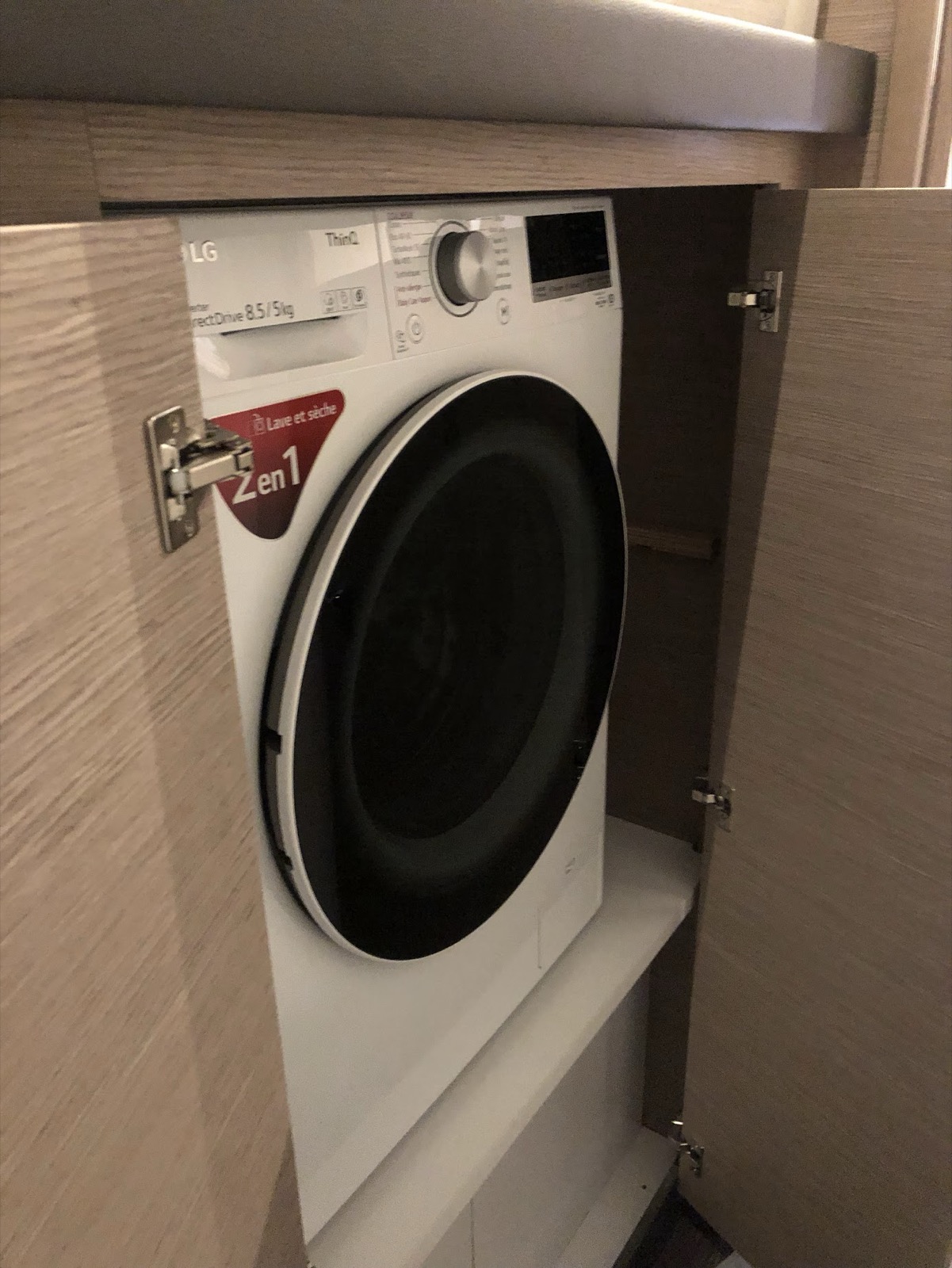
The LG washer/dryer sits in a cabinet in the stbd side